Note (2026-01-07)
最近在上成人英语课程,用 Interchange 系列教材,教书用书里对 CEFR, IELTS, TOEFL 以及 TOEIC 对标的说明:
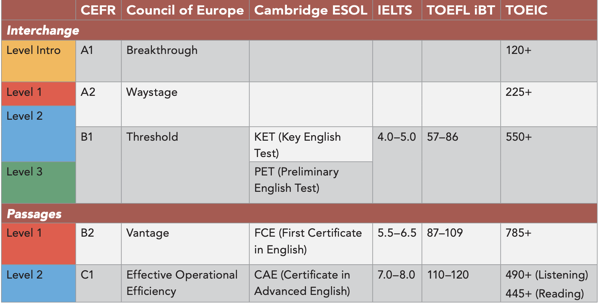
另外,教室用书里面提到的 essential teaching tips 蛮有用:
Classroom management
Error correction
- During controlled practice accuracy activities, correct students’ wrong use of the target language right away, either by correcting the error yourself or, whenever possible, by having the student identify and/or correct the error. This way, the focus is on accuracy, and students can internalize the correct forms, meaning, and use of the language.
- During oral fluency activities, go around the room and take notes on errors you hear. Do not interrupt students. Instead, take note of their errors in the use of target language and write these errors on the board. Encourage students to correct them first. Be sure to point out and praise students for language used correctly as well.
Grouping students
- It is good to have students work in a variety of settings: individually, in pairs, in groups, and as a class. This creates a more student-centered environment and increases student talking time.
- The easiest and quickest way to put students in pairs is to have two students sitting close to one another work together. This is good for when students need to have a quick discussion or check answers.
- To ensure students don’t always work with the same partner and/or for longer activities, pair students by name, e.g., Maria work with Javier.
- One way to put students in groups is to give them a number from 1 to 4, and then have all number 1s work together, all number 2s work together, and so forth.
Instructions
- Give short instructions and model the activity for the students.
- Check your instructions, but avoid asking, Do you understand? Instead ask concept questions such as, Are you going to speak or write when you do this activity?
Monitoring
- Make sure you go around the room and check that the students are doing the activity and offer help as necessary.
- Monitor closely during controlled practice, but don’t make yourself too accessible during fluency activities; otherwise, students may rely on you to answer questions rather than focus on communicating their ideas to their partner or group.
Teaching lower-level students
- Teach the Classroom Language on page xxiii and put useful language up in the classroom, so the students get used to using English.
- Don’t rush. Make sure all the students have had enough time to practice the material.
- Do a lot of repetition and drilling of the new target language.
- Encourage students to practice and review target language by doing activities in the Workbook and Self-study.
- Elicit answers from your students and involve them in the learning process. Even though they are beginners, they may have a passive knowledge of English. Find out what they already know by asking them questions.
- Use the optional activities within the Teaching Notes and the Supplementary Resources
- Overview charts at the beginning of each unit in this Teacher’s Edition to add variety to your lessons.
Teaching reading and listening
- Reading and Listening texts are meant to help the students become better readers/ listeners, not to test them. Explain to your students why they need to read or listen to a text several times.
- Adapt the reading speed to the purpose of the reading. When the students read for gist, encourage them to read quickly. When students read for detail, give them more time.